Top Trends in Lithium Batteries for 2025 and Their Impact on Technology
As the world moves toward a greener and more sustainable future, the evolution of lithium batteries is set to play a crucial role in shaping technological advancements by 2025. The increasing demand for efficient energy storage solutions is pushing researchers and manufacturers to explore innovative designs, materials, and applications for lithium batteries. Dr. Emily Chen, a leading expert in the field of battery technology, emphasizes, "The advancements in lithium batteries will not only redefine energy storage but also accelerate the transition to renewable energy sources."
The trends projected for lithium batteries are aimed at enhancing performance, improving safety, and reducing costs. With innovations like solid-state batteries and advanced recycling techniques on the horizon, the implications for various sectors, from electric vehicles to renewable energy systems, are substantial. Moreover, the integration of artificial intelligence and smart technologies into lithium battery management systems is poised to optimize their efficiency and lifespan.
As we anticipate these developments, it is clear that lithium batteries will be at the forefront of the next technological revolution, enabling a smarter, cleaner, and more sustainable world. The impact of these advancements will resonate across industries, ensuring that energy storage is no longer a bottleneck but a catalyst for growth and innovation.

Emergence of Solid-State Lithium Batteries and Their Benefits
The emergence of solid-state lithium batteries represents a pivotal advancement in energy storage technology, particularly as we approach 2025. Unlike traditional lithium-ion batteries that use liquid electrolytes, solid-state batteries utilize a solid electrolyte, which enhances safety by significantly reducing the risk of flammability and leakage. According to a report by IDTechEx, the solid-state battery market is expected to grow from approximately $100 million in 2020 to over $3 billion by 2026, indicating a remarkable compound annual growth rate (CAGR) of over 50% as these technologies become more commercially viable.
One of the most significant benefits of solid-state lithium batteries is their potential to deliver higher energy densities. These batteries can surpass the energy density of traditional lithium-ion batteries by 30-50%, which translates to longer-lasting power for electric vehicles and portable electronics. Furthermore, solid-state batteries have a much longer cycle life, with some studies indicating they can endure over 1,000 charge-discharge cycles without significant degradation compared to around 500 cycles for conventional batteries. This longevity not only provides economic advantages over time but also aligns with the growing demand for sustainable and reliable energy solutions, as highlighted in the latest McKinsey report on future energy storage trends.
The transition to solid-state technology is expected to revolutionize electric mobility and renewable energy systems, pushing the boundaries of what is possible with energy storage. Given that global battery demand is projected to reach 2,500 GWh by 2030, the adoption of solid-state solutions may well define the future landscape of energy technology, shaping the way we approach everything from electric vehicles to grid storage solutions.
Advancements in Lithium Battery Recycling Technologies
The advancement of lithium battery recycling technologies is critical as the demand for lithium batteries continues to surge, driven by the electrification of transportation and the proliferation of renewable energy storage solutions. According to a recent report from the International Energy Agency (IEA), by 2025, lithium-ion battery demand is expected to increase nearly fivefold, necessitating a robust recycling infrastructure to address the resulting environmental concerns.
Innovations in recycling methods, such as hydrometallurgical and pyrometallurgical processes, show promise in improving recovery rates for critical materials like lithium, cobalt, and nickel, thereby reducing reliance on virgin mineral extraction.
Emerging technologies, such as direct recycling techniques, are also gaining traction, offering the potential to minimize energy consumption and waste generation during the recycling process. A study from the U.S. Department of Energy estimated that these new approaches could enhance material recovery rates to over 90%, significantly reducing costs and preserving valuable resources. As the industry moves towards a circular economy, not only will improved recycling technologies mitigate environmental impacts, but they will also play a vital role in stabilizing supply chains for battery manufacturers, ultimately ensuring that the future of energy storage is both sustainable and efficient.
Influence of Battery Management Systems on Performance and Safety
As the demand for lithium batteries continues to rise, the role of Battery Management Systems (BMS) in enhancing performance and ensuring safety becomes more critical. A well-designed BMS regulates many aspects of battery operation, including charging, discharging, and temperature control. By monitoring each cell within a battery pack, the BMS can prevent issues such as overcharging or overheating, which are common causes of battery failure. In advanced setups, BMS technologies integrate predictive algorithms that analyze usage patterns to optimize the battery's lifespan and performance.
Tips for maximizing battery performance with a BMS include regular software updates, which enhance system reliability and introduce new safety features. Additionally, utilizing temperature monitoring can prevent thermal runaway, a condition that may occur if batteries are exposed to extreme conditions. Users should also periodically calibrate their BMS to ensure it accurately reflects the battery’s health and state of charge, further preventing potential hazards.
The influence of BMS technology goes beyond safety; it is integral to the overall efficiency of battery-powered devices. As innovations continue, expect smarter BMS designs that can adapt in real-time to operational conditions and even communicate with the device they power. This seamless integration will drive advancements in various sectors, from electric vehicles to renewable energy storage, highlighting the essential role of battery management systems in the future landscape of lithium battery technology.
Top Trends in Lithium Batteries for 2025 and Their Impact on Technology
This chart illustrates the projected advancements in lithium battery technology by 2025, focusing on key metrics such as energy density, cycle life, charging speed, cost per kWh, and environmental impact measured in CO2 emissions. These trends reflect the influence of enhanced battery management systems on overall performance and safety.
Trends in Lithium Battery Manufacturing and Sustainability Practices
The manufacturing landscape of lithium batteries is evolving rapidly, driven by the growing demand for energy storage solutions across various sectors. One significant trend is the shift towards more sustainable manufacturing practices. Technologies like green chemistry and recycling methodologies are being increasingly integrated into the production chain. By focusing on minimizing waste and lowering carbon emissions during the manufacturing process, companies can enhance the environmental compatibility of lithium batteries. This is not only beneficial for the planet but also aligns with corporate social responsibility goals that many manufacturers are adopting.
Another important aspect of sustainability in lithium battery production is the sourcing of raw materials. Efforts are being made to implement responsible mining practices and to explore alternative materials that can reduce reliance on lithium and cobalt. The concept of circular economy is gaining traction, where end-of-life batteries are repurposed or recycled to recover valuable components, thereby reducing the need for newly mined materials. This holistic approach not only addresses the environmental challenges associated with lithium battery production but also fosters innovation in battery technology, opening pathways for more efficient and eco-friendly energy storage solutions in the future.
Top Trends in Lithium Batteries for 2025 and Their Impact on Technology
| Trend |
Description |
Impact on Technology |
Sustainability Practices |
| Solid-state Batteries |
Developing safer and more efficient lithium batteries using solid electrolytes. |
Higher energy density and improved safety for electric vehicles. |
Reduced risk of leakage and shorter lifecycle. |
| Recycling Innovations |
New methods for recycling lithium-ion batteries to recover materials. |
Supports circular economy in battery manufacturing. |
Decreases environmental impact through material recovery. |
| Battery Management Systems (BMS) |
Advanced systems for monitoring and optimizing battery performance. |
Enhances battery lifespan and efficiency. |
Promotes responsible usage and reduces waste. |
| High-Performance Anodes |
Use of silicon and other materials to enhance anode performance. |
Increases energy storage capacity significantly. |
Encourages the use of abundant materials. |
| Sustainable Sourcing |
Focus on ethically and sustainably sourced raw materials. |
Improves supply chain sustainability. |
Reduces ecological footprint of battery production. |
Predicted Market Growth and Applications for Lithium Batteries in 2025
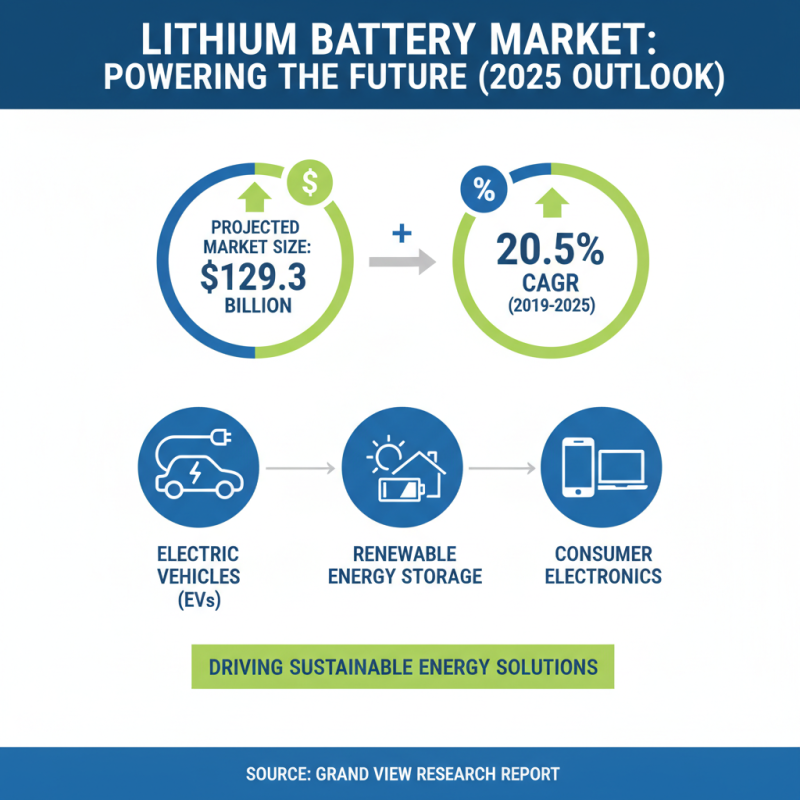
As we approach 2025, the lithium battery market is poised for remarkable growth, driven by an increasing demand for sustainable energy solutions across various sectors. According to a recent report by Grand View Research, the global lithium-ion battery market is projected to reach $129.3 billion by 2025, expanding at a compound annual growth rate (CAGR) of 20.5% during the forecast period. This rapid growth highlights the pivotal role lithium batteries play in technologies such as electric vehicles (EVs), renewable energy storage, and consumer electronics.
One of the most significant applications of lithium batteries will be in the electric vehicle sector, where the shift towards greener alternatives is accelerating. The International Energy Agency forecasts that the number of electric cars on the road will dramatically increase, reaching 145 million by 2030. This surge necessitates advancements in battery technology to enhance efficiency and increase energy density, enabling longer ranges and faster charging times. Furthermore, as energy storage systems become critical in integrating renewable energy sources, lithium batteries will provide the necessary support to stabilize energy grids, making renewable technologies more viable and widespread.

 +86-13928815851
 CONTACT NUMBER
 CONTACT NUMBER