+86-13928815851
Leave Your Message
-
CONTACT NUMBER
-
 CONTACT NUMBER
-
 CONTACT NUMBER
Industrial plants need storage that can handle heat, cycling, and demanding duty schedules. A battery beside a furnace may face hot ambient air, dust, vibration, and limited cooling space. High Temperature Battery systems can suit these settings, but operating temperature alone does not prove industrial fitness. Safety controls, service life, maintenance access, and total installed cost matter too. Heat has trade-offs.
The International Energy Agency’s Batteries and Secure Energy Transitions report says battery storage additions in the power sector rose about 130% in 2023, reaching roughly 42 GW. That growth signals rising interest in storage, not a guarantee that one chemistry fits every factory. The U.S. Department of Energy’s 2022 Grid Energy Storage Technology Cost and Performance Assessment describes sodium-sulfur batteries as high-temperature systems, typically operating around 300–350°C. Such figures help explain why insulation and thermal management belong in any serious comparison.
This guide examines seven battery options for industrial use, including established high-temperature chemistries and alternatives suited to specific operating conditions. It considers temperature range, discharge duration, response time, safety design, and real-world deployment needs. A specification sheet can look convincing. Yet performance may change with ambient conditions, operating patterns, and maintenance quality. Buyers should verify vendor claims against independent testing and site data; even a careful shortlist cannot replace an engineering review.
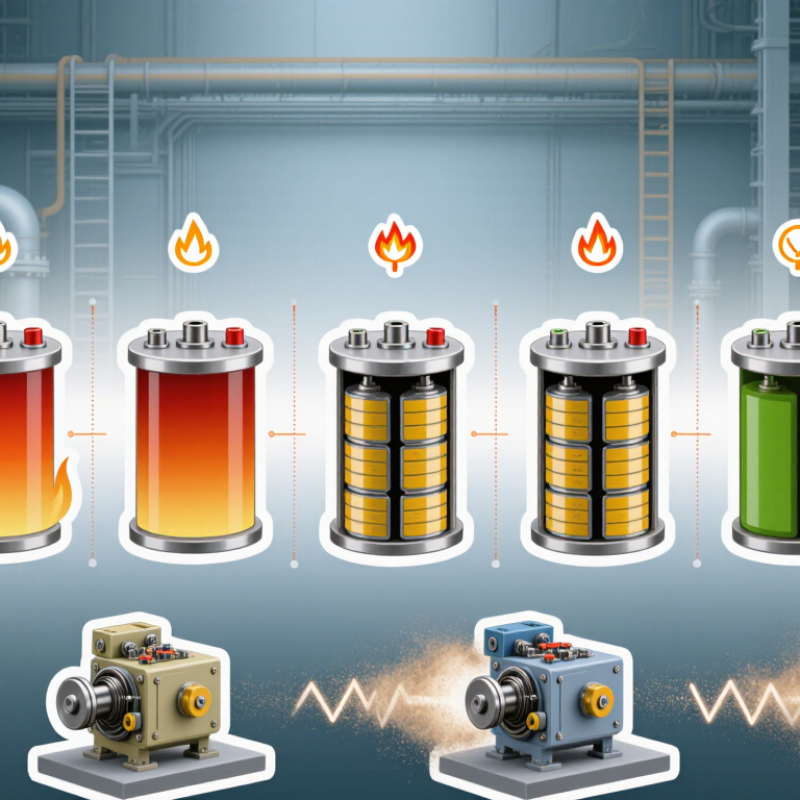
Industrial heat is not one steady temperature. A furnace may run hot for hours, while nearby control rooms cycle between warm shifts and overnight cooling. The U.S. Department of Energy’s 2015 Quadrennial Technology Review reports that process heating accounts for about half of U.S. manufacturing energy use. That figure signals scale, not a battery specification. Real sites are messier. A battery beside a furnace faces radiant heat, dust, vibration, and abrupt load changes; one in a conditioned room may face only short temperature spikes.
Battery selection should follow measured cell-level temperatures, duty cycles, and required discharge duration. Record temperatures across a full production week, including shutdowns; a single peak reading is a poor design basis. The DOE/EPRI Electricity Storage Handbook describes sodium-sulfur batteries as operating internally around 300–350°C. That is a controlled operating temperature, not permission to mount a battery beside a hot process. Ambient-temperature ratings, cooling needs, insulation, and cycle life still require verification from technical test data. For lithium-based systems, sustained heat can accelerate degradation, so thermal monitoring and protective controls matter. Keep the pack out of direct radiant heat where possible. It sounds obvious, but plant layouts often make it difficult. A specification that ignores hot-start conditions may look adequate on paper and disappoint during repeated shifts.
This shortlist compares battery chemistries for different industrial heat profiles. “Best” depends on whether the battery itself must operate hot or merely tolerate a warm ambient environment; the temperature figures below are indicative and are not directly comparable across those two cases.
| Battery Type | Indicative Temperature Range | Rechargeable? | Industrial Heat Profile | Strengths | Key Limitations |
|---|---|---|---|---|---|
| Sodium-sulfur (NaS) | Cells typically operate internally at about 300–350°C; the battery system must maintain this elevated temperature. | Yes | Stationary energy storage where a continuously hot, insulated battery installation is acceptable. | Suitable for large-scale energy storage and repeated charge-discharge cycling. | Requires thermal management and careful containment; high internal operating temperature creates specific safety and maintenance requirements. |
| Sodium-nickel chloride (Na-NiCl2) | Cells typically operate internally at about 270–350°C; system temperature is actively managed. | Yes | Stationary or mobile applications that can accommodate insulation, heaters, and hot standby operation. | Rechargeable high-temperature chemistry with no need to keep the battery at ordinary ambient temperature during operation. | Heat-up time and standby heat losses matter; performance and operating limits depend on the complete battery system. |
| Molten-salt thermal battery | Once activated, the electrochemical stack commonly runs at several hundred degrees Celsius; activation temperatures vary by design. | No; generally primary and single-use | Short-duration power in extreme heat, harsh environments, or applications requiring long shelf storage before activation. | Can remain inactive for extended storage and deliver power after thermal activation. | Not intended for routine recharging or continuous industrial cycling; output duration and activation method are design-specific. |
| Lithium-titanate (LTO) lithium-ion | Some cells specify discharge down to approximately −30°C and up to around 55–60°C; charging limits are usually narrower and product-specific. | Yes | Warm industrial sites needing frequent cycling, high power, or rapid charging without maintaining a high-temperature cell core. | Often selected for high cycle life and strong power capability compared with many conventional lithium-ion designs. | Elevated temperature still accelerates aging; verify the manufacturer’s continuous operating, charging, and storage limits. |
| Lithium iron phosphate (LFP) lithium-ion | Typical cell specifications often allow discharge to roughly 55–60°C, with a lower maximum charging temperature; exact limits vary. | Yes | Industrial backup and storage in moderately warm environments with suitable ventilation and temperature monitoring. | Widely used for stationary storage; thermal and cycle-life characteristics can suit demanding industrial duty. | Not designed for sustained extreme heat. High cell temperature can shorten service life, and charging limits must be observed. |
| Industrial nickel-cadmium (Ni-Cd) | Many industrial designs support discharge around −20°C to +50°C; charging limits are typically narrower and design-dependent. | Yes | Rugged standby or industrial service where ambient temperatures fluctuate and established maintenance practices are available. | Robust performance in demanding environments and good tolerance of varied operating conditions in suitable designs. | Cadmium requires controlled handling and recycling; high ambient temperature can still reduce service life. |
| Valve-regulated lead-acid (VRLA) | Common designs are specified for moderate ambient conditions; operation near or above 40°C can substantially accelerate aging. | Yes | Cost-sensitive backup power in warm but controlled rooms, with ventilation and temperature compensation where required. | Established technology with broad availability and straightforward integration into many standby systems. | Generally a poor choice for sustained high-temperature exposure; elevated heat can shorten life and increase maintenance or replacement frequency. |
Selection note: Confirm temperature limits for the complete battery system—not just the cell—including charging, continuous discharge, storage, enclosure, and safety controls. For installations exposed to sustained high ambient heat, thermal management, duty cycle, expected lifetime, and applicable safety standards should be assessed before selection.